

In Part 5 of our series we looked at the first of the expanded forms of the blessing that can take place at the end of Mass, the Prayer over the People. We can now move on to look at the second form, the Solemn Blessing.
The Solemn Blessing involves adding a number of elements to this part of the liturgy. The first is similar to the Prayer over the People: the instruction to “Bow down for the blessing”.
Again, this is a simple instruction, given by the Deacon (or the Presider if there is no Deacon), and, similarly to its use in a Prayer over the People, highlights for members of the Assembly that something ‘different’ is taking place.
Again, after the instruction is given, the Presider extends his hands over all of the Assembly as a sign of calling down God’s blessing on them.
What is different in a Solemn Blessing from a Prayer over the People, however, is what comes next.
Instead of the quite compact text used in a Prayer over the People, the Solem Blessing uses a three-part text, with each part inviting the Assembly’s response of “Amen”.
There can be a practical difficulty here in eliciting the Assembly’s response, since there is no verbal cue (such as “Through Christ our Lord”) to prompt the response, at least initially. Presider’s need to be attentive to this, and speak in such a way during each of the three parts of the Solemn Blessing in such a way that the Assembly has some clue as to when to say “Amen”. This, however, is more art than science.
Each part of the three-fold Solemn Blessing speaks of the occasion for which it has been crafted, and often speaks beautifully and poetically about what God has already done and will continue to do for humankind’s benefit.
After the three-fold invocation, the Presider concludes the blessing using the same words used in a Prayer over the People:
And may the blessing of almighty God, the Father, and the Son, and the Holy Spirit, come down on you and remain with you forever.
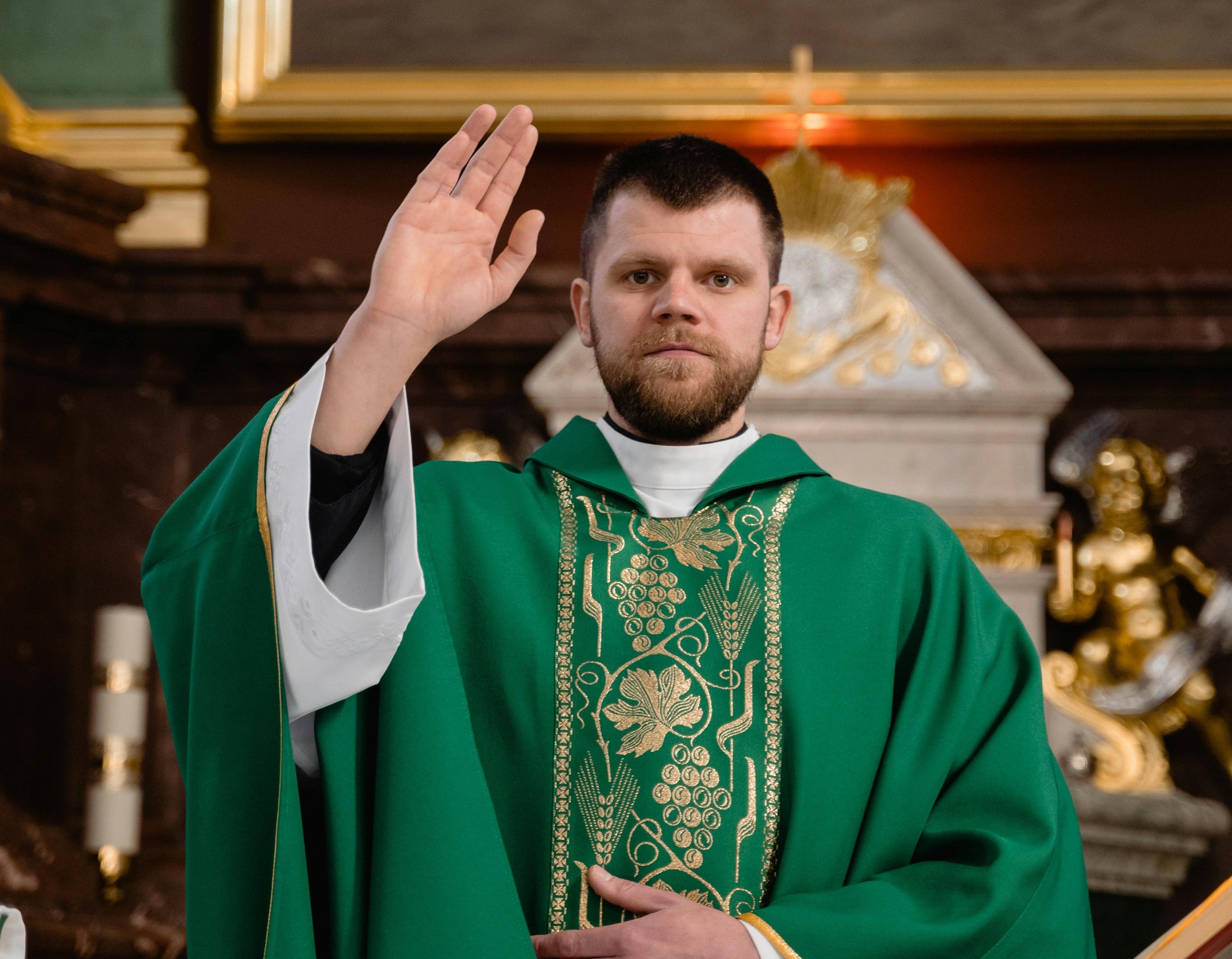
These words, of course, are accompanied by the Presider making the sign of the cross over the Assembly, and the Assembly responding in the usual way (see Part 4).
The texts for a wide range of Solemn Blessings can be found in The Roman Missal on pages 709-721, and cover a very broad range of possibilities in terms of occasions and seasons. In a manner similar to Prayers over the People, some Solemn Blessings are associated with particular feasts in the liturgical calendar and are thus found on the relevant page of the Missal associated with that feast. The recent celebration of the Easter Vigil provides a good example of this, as would the celebration of Christmas or Pentecost.
Again, in a similar manner to Prayers over the People, sometimes the use of a Solemn Blessing is compulsory and sometimes optional. The nature of the occasion is the determining factor, and the Missal will usually provide guidance on the status.
And that is the second form of the expanded Greeting and Blessing that is sometimes encountered at the end of Mass.
As an aside, the Missal indicates that the use of either a Solemn Blessing or a Prayer over the People is not limited to Mass. The rubric found in the Missal on page 709 and 722 indicates that they can be used
…at the discretion of the [Presider], at the end of the celebration of Mass, or of a Liturgy of the Word, or of the Office, or of the Sacraments.
The option of including these beautiful prayers of blessing at the end of other liturgical celebrations brings with it the possibility of adding solemnity to an occasion via the simple inclusion of one of them. Imagine the possibilities for all sorts of liturgical occasions that could open up if such options were used more often.
And having looked at all three of the forms of the Greeting & Blessing, we can now move on to the next of the four elements of the Concluding Rites, the Dismissal of the People. But that can wait until Part 7.
To be continued…