

Together with the Liturgy of the Word, which we have covered in a previous series, the Liturgy of the Eucharist is one of the two major divisions of our celebration of Mass, the most familiar liturgical form experienced by most Catholics, and one celebrated every Sunday along with the major feasts and liturgical occasions.
Focussed on the second of the ‘Two Tables’, this time the Altar rather than the Ambo, the Liturgy of the Eucharist is of such significance that it can sometimes give its name to the whole celebration (“the Eucharist”).
In opening its dealing with the Liturgy of the Eucharist, the General Instruction of the Roman Missal (GIRM) has this to say:
At the Last Supper Christ instituted the Paschal Sacrifice and banquet, by which the Sacrifice of the Cross is continuously made present in the Church whenever [a] Priest, representing Christ the Lord, carries out what the Lord himself did and handed over to his disciples to be done in his memory.
… Hence, the Church has arranged the entire celebration of the Liturgy of the Eucharist in parts corresponding to precisely [the] words and actions of Christ… (n.72)
These “words and actions of Christ” can be summarised in four words – Take, Bless, Break, Give. This simple slogan neatly and concisely indicates what will take place across the duration of the Liturgy of the Eucharist.
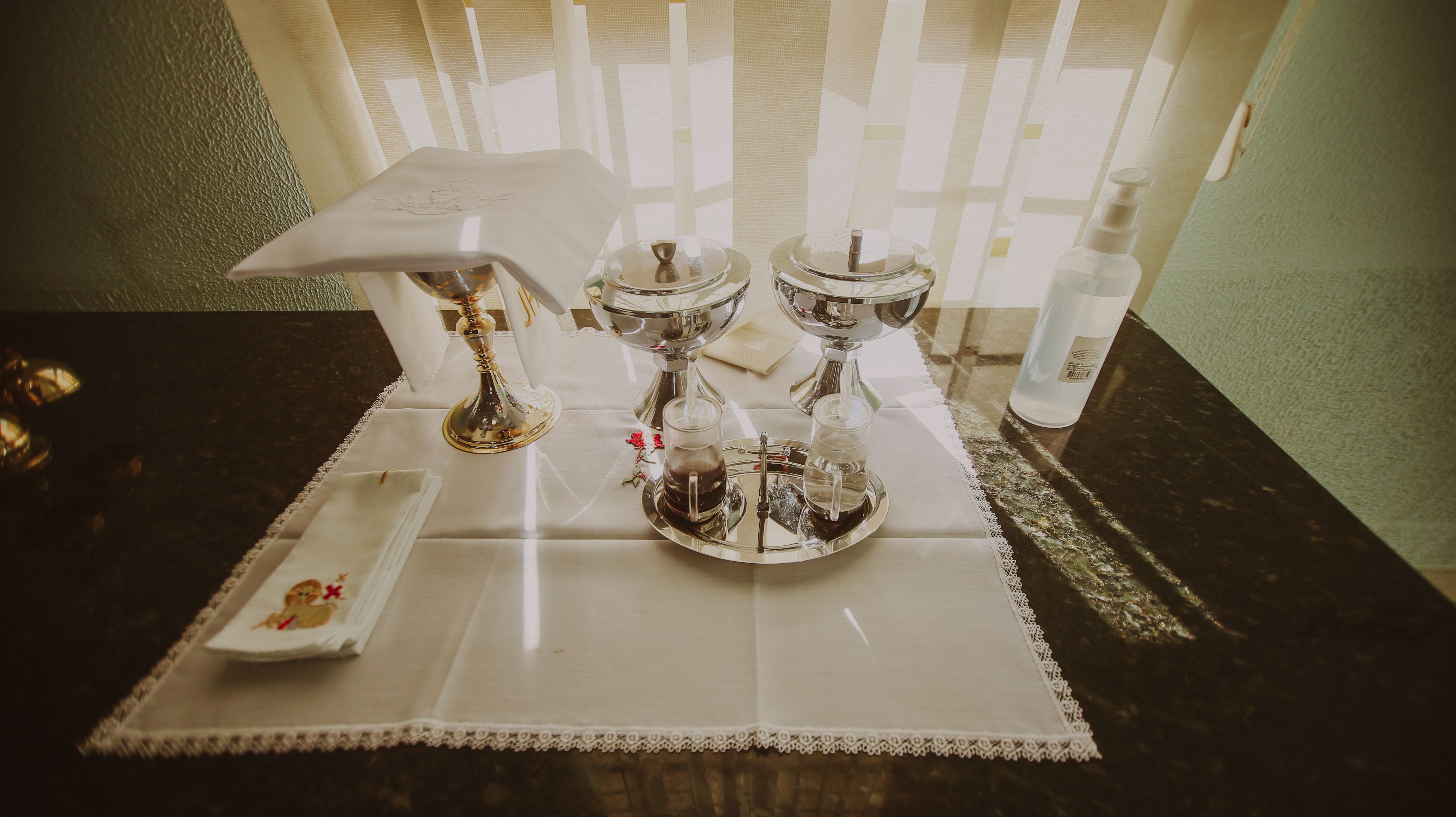
Firstly, the gifts of bread and wine are brought forward and prepared at the Altar (“Take”), then the great prayer of thanksgiving, the Eucharistic Prayer, is prayed over them, and us (“Bless”), before they are prepared (“Break”) to be given to the gathered assembly as communion (“Give”).
It is also important to remember that the Liturgy of the Eucharist is rehearsing the “words and actions of Christ”. Not just words, not just actions but words and actions, which combination is fundamental to a Catholic understanding of liturgy. Indeed, this combination, this ritual ‘language’, is to be found at the heart of a Catholic approach to all liturgies.
In that light, it is important as we move through our exploration of the Liturgy of the Eucharist to pay attention to both aspects, to both words and actions, so we can better approach a fuller and deeper understanding of what it is that is taking place during this part of our celebration of Mass, and its connection to the other parts that we have already explored.
Next week, with the arrival of Part 2, we will begin our exploration of the Liturgy of the Eucharist in more detail. Over coming weeks we will unpack the true significance of these “words and actions”.
To be continued…