

At the end of Part 5, we had arrived at the point where the Presider was about to start speaking aloud the words of the Eucharistic Prayer, that prayer of the entire assembly to which the Presider gives voice.
It may be of interest to readers that there are ten Eucharistic Prayers currently authorised for use with The Roman Missal, with seven of these appearing in the Missal itself and the other three being found elsewhere.
In addition to the well-known Eucharistic Prayers I-IV, The Roman Missal also features two Eucharistic Prayers for Reconciliation and one Eucharistic Prayer for use in Masses for Various Needs. This latter Eucharistic Prayer comes in four variations, which some people suggest means there are, in fact, thirteen authorised Eucharistic Prayers currently in force.
In other resources there is to be found the three Eucharistic Prayers for Masses with Children. The reason for them being in a separate resource is a simple one: they are not found in the Latin original, and therefore they are not found in the English translation. It is one of the peculiarities of the current translation regime applicable to the liturgies of the Latin Church.
Although the choice of which Eucharistic Prayer is used on a particular occasion is primarily at the discretion of the Presider, the General Instruction of the Roman Missal (GIRM) does provide some guidance later within its text (see n.365).
The Eucharistic Prayer is made up of a number of elements, each of which is significant both in itself and as part of the whole. These elements are outlined in the GIRM in n.79.
The first of these elements is thanksgiving, which is expressed most especially in the Preface that is part of the Eucharistic Prayer.
There are numerous Prefaces available in the Missal, each serving to “bring out more fully the motives for thanksgiving” and setting out in various ways “the different facets of the mystery of salvation” (GIRM, n.364).
Some of the Prefaces are applicable to only one celebration of the liturgical year, others are applicable to particular liturgical seasons, while others are more generic and can be used on a number of occasions.
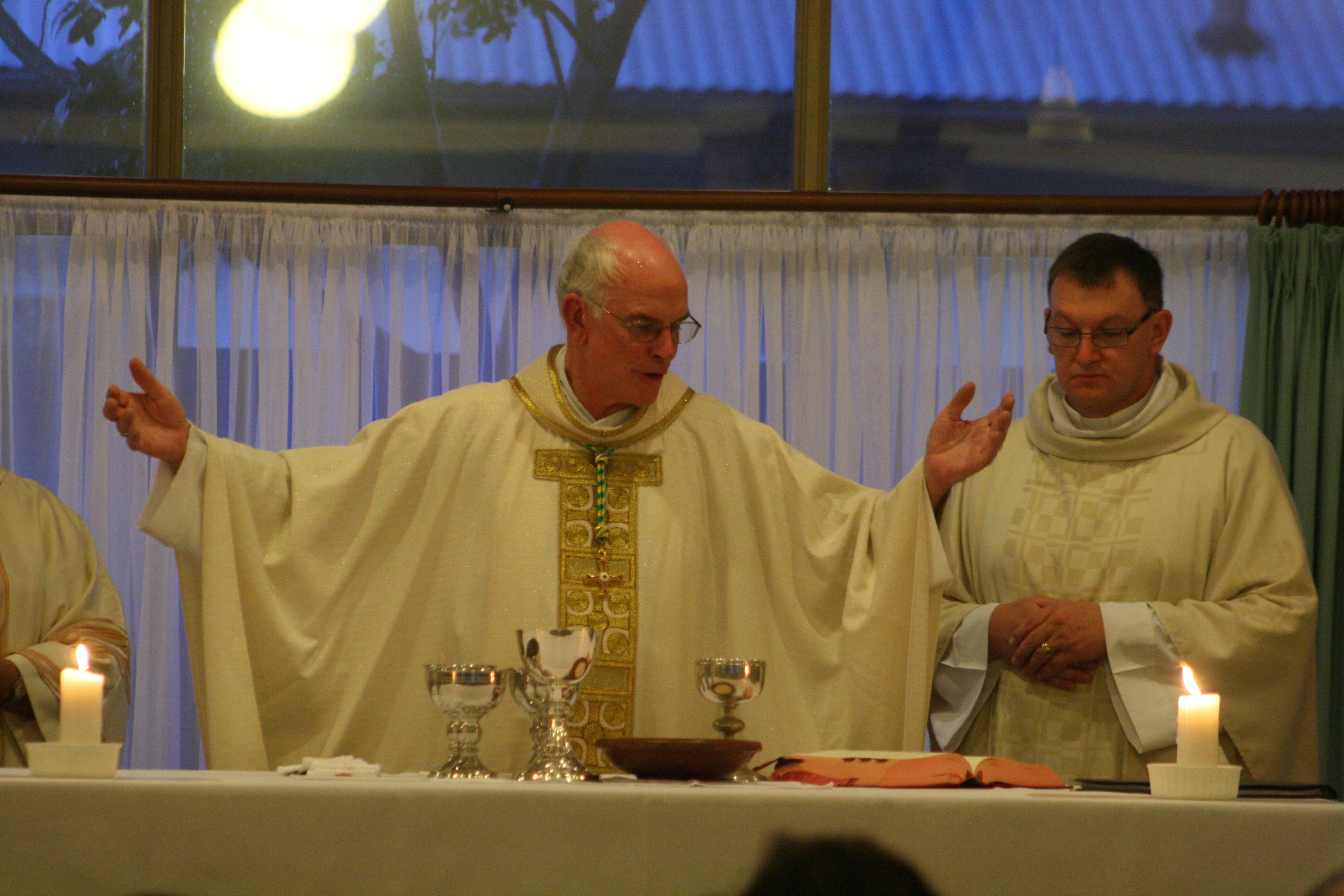
Indeed, some of the Eucharistic Prayers mentioned above have their own Preface associated with them either by default or invariably. In the case of those with invariable Prefaces, this limits the times when those particular Eucharistic Prayers can be used.
The Preface begins with a dialogue between the Presider and the assembly, starting with the ubiquitous “The Lord be with you”. The words of the primary part of the Preface, which is spoken aloud by the Presider on behalf of all those who have gathered, “glorifies God the Father and gives thanks to him for the whole work of salvation or for some particular aspect of it” (GIRM, n.79a).
Towards the end of the Preface, the prayer transitions to the second constitutive element of the Eucharistic Prayer, with the Presider inviting the assembly to join the heavenly powers in acclamation, by joining in the Sanctus (Holy, Holy, Holy), the first of what are sometimes referred to as the Eucharistic Acclamations.
Like all such acclamations found during the liturgy, it is preferable for the Sanctus to be sung, and to be sung by the whole assembly. If for some reason it is not possible to be sung, then it is said by all those who are present (GIRM, n.79b).
After the Sanctus has been sung or said, the assembly kneels, ready to participate in the remainder of the Eucharistic Prayer in reverent silence (cee GIRM, n.78).
Sometimes it is seen that members of the assembly begin to kneel before the Sanctus is finished, but we should be careful to ensure that we do not cut short our participation in the Sanctus by doing so nor unduly anticipate our change of posture for what is still to come.
When the Sanctus is completely finished, then we kneel, and the Presider waits until the assembly has changed posture and settle once more before continuing to voice the Eucharistic Prayer in the name of all those who have gathered.
There is no need to rush this; we have plenty of time to offer “the centre and high point of the entire celebration” (see GIRM, n.78).
Next week, in Part 7 of our exploration of the Liturgy of the Eucharist, we will continue looking at the nature and content of the Eucharistic Prayer.
To be continued…