The Liturgy of the Eucharist - Part 10
Part ten of a series I’m writing for inclusion in the weekly bulletin of St Francis of Assisi Parish, Dungog Gresford

In the last part we had come to the memorial acclamation that is found in the Eucharistic Prayer, which as we shall see is bridge to the next component of the Prayer, known as the anamnesis.
The anamnesis, which has the same Greek origin as amnesia, is the word used to describe the remembering that we are called to undertake in keeping with the Lord’s command to “Do this in memory of me”.
The General Instruction of the Roman Missal describes this part of the Eucharistic Prayer as that part
“by which the Church, fulfilling the command that she received from Christ the Lord through the Apostles, celebrates the memorial of Christ, recalling especially his blessed Passion, glorious Resurrection and Ascension into heaven.” (GIRM, n.79e)
Rather than being a simple reenactment of the Last Supper, the anamnesis reminds us that we are participating in the very sacrifice of the Last Supper, a reality that is not bound by time and space.
The remembering of the anamnesis means that what we do in our churches every time we celebrate Eucharist spans the limitations of time so that we are participating in the very action of Jesus Christ himself.
Having memorialised the great action of Jesus in the anamnesis, we then participate in the oblation, by which the gathered Church offers “the unblemished sacrificial Victim in the Holy Spirit to the Father” (GIRM, n.79f).
Alongside this offering, the meaning of the word oblation, the Church, especially those members gathered for the particular celebration in question, learns to offer their very selves as well so that they can be brought “through the mediation of Christ, into unity with God and with each other, so that God may at least be all in all” (GIRM, n.79f).
These two aspects of the Eucharistic Prayer are intimately linked and, depending on which Prayer is used, may be hard to identify separately. Nevertheless, they remain important aspects of the Eucharistic Prayer, calling our attention to the reality that the Eucharist is first and foremost the action of Christ to which we have been invited and in which we participate.
Following the anamnesis and the oblation, the Eucharistic Prayer moves on to the intercessions, the inclusion of which sometimes surprises some people when hearing that description. And yet, they are an important element of the Eucharistic Prayer, giving expression to and reminding us of why the Eucharist is celebrated.
The intercessions found in the Eucharistic Prayer, unlike those found at the end of the Liturgy of the Word, give expression
“to the fact that the Eucharist is celebrated in communion with the whole Church, of both heaven and earth, and [is offered] for her and for all her members, living and dead” (GIRM, n.79g).
These intercessions, in and of themselves, remind us that the celebration of Eucharist is not just about us who are gathered; the celebration of Eucharist is much broader than that.
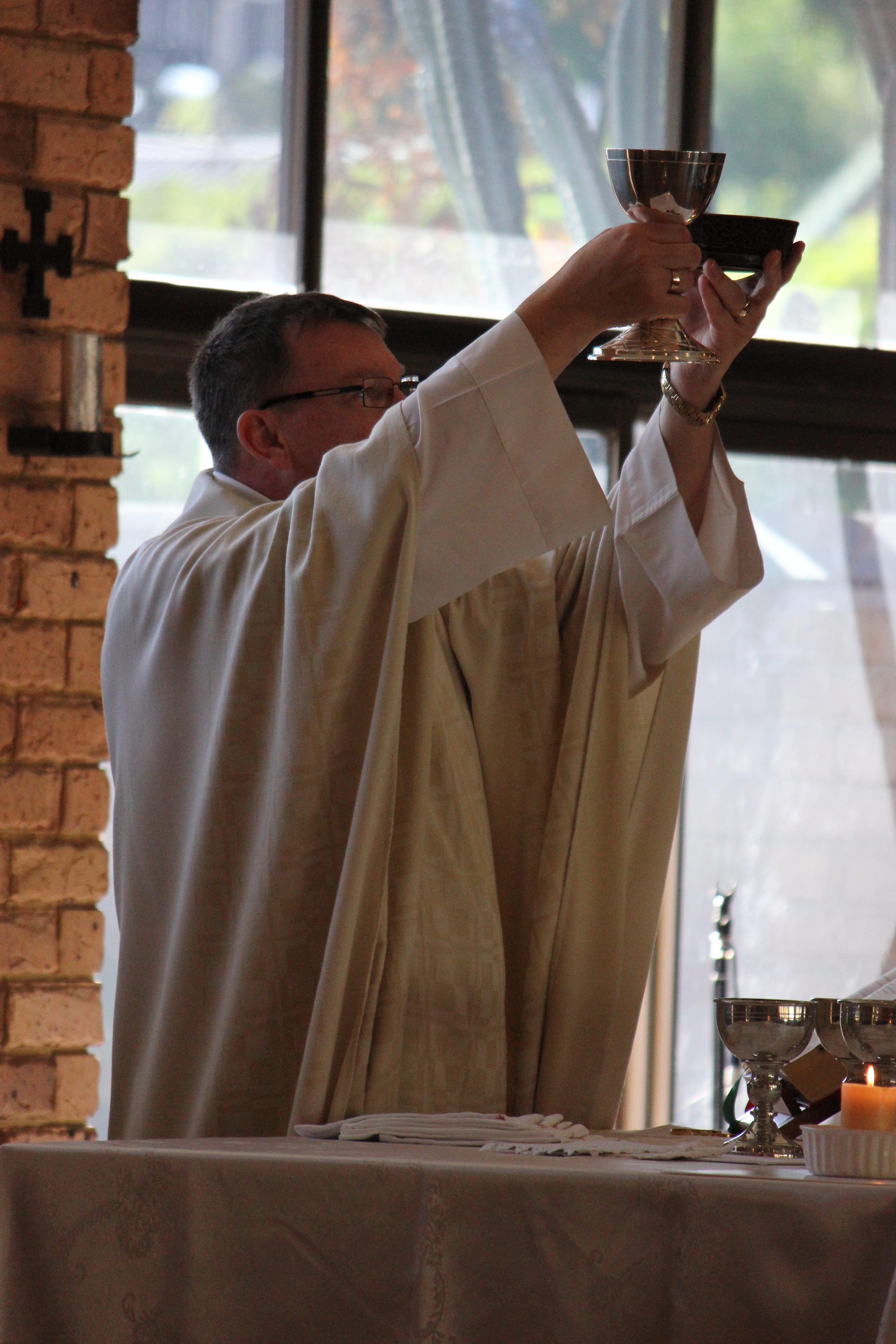
The last component of Eucharistic Prayer is the concluding doxology, that moment during which the Presider takes both the paten containing the consecrated host and the chalice in his hands, and elevates them while saying “Through him, with him, and in him…”. This is the one true elevation that occurs during the Eucharistic Prayer.
The GIRM tells us this is the moment “by which the glorification of God is expressed and which is affirmed and concluded by the people’s acclamation” (n.79h). That acclamation is the simple yet powerful “Amen”.
And as the sound of the Amen of the concluding doxology fades, we move on to the next part of the Liturgy of the Eucharist. But that can wait until Part 11 of the series.
To be continued…
Discussion about this post