

We pick up our exploration of the Eucharistic Prayer from Part 6, having joined in the acclamation that is the Sanctus (Holy, Holy, Holy) and knelt as the Presider continues to give voice to the assembly’s prayer.
After briefly continuing the theme of acclamation, the Presider then moves into the epiclesis, that part of the Eucharistic Prayer in which
by means of particular invocations, the Church implores the power of the Holy Spirit that the gifts offered by human hands be consecrated, that is, become Christ’s Body and Blood (GIRM, n.79c).
This invocation of the Holy Spirit over the gifts of bread and wine is a very powerful reminder that the consecration of bread and wine into the Body and Blood of Christ is not caused by human action, but is truly the action of the Holy Spirit.
The invocation of the Holy Spirit, the epiclesis, is achieved not only in words but in actions. It is during this part of the Eucharistic Prayer that the Presider (and concelebrants if present) first joins his hands together and then holds them extended over the bread and wine, palms down, during the invocation of the Holy Spirit (see Order of Mass, n.109) before finally making the sign of the cross once over the bread and chalice.
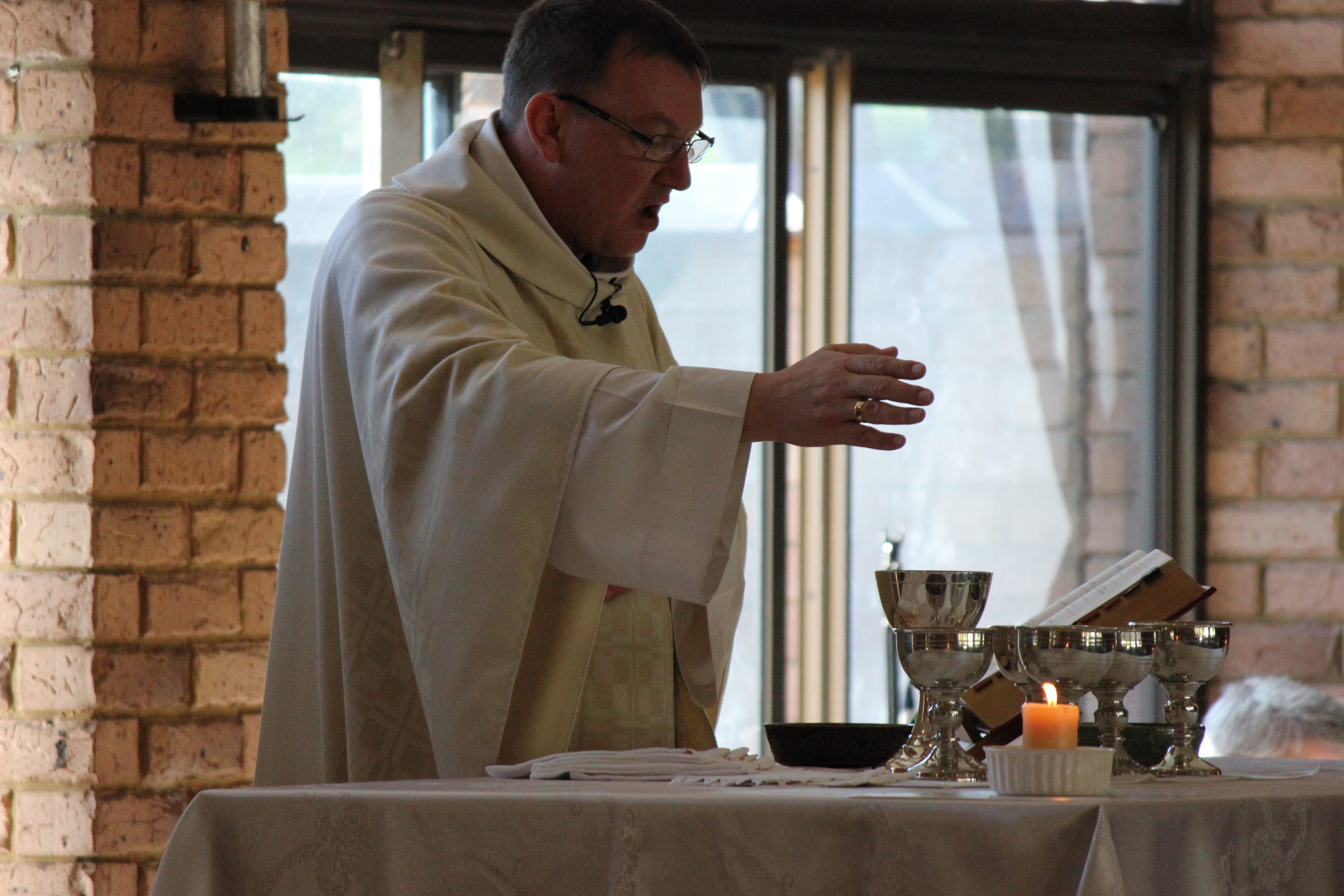
This action on the part of the Presider may be accompanied by the ringing of bells as a “signal to the faithful” (GIRM, n.150). This is not a requirement per se and only takes place “if appropriate”.
It is to be regretted that there are times when the epiclesis is missed by some members of the assembly because they are more intent of focussing on the contents of their personal missal, rather than being attentive to the invocation of the Holy Spirit over the bread and wine that will become the Body and Blood of Christ.
If the ringing of “a small bell” (GIRM, n.150) helps people to become attentive to what is being prayed in word and action, then perhaps such a bell should be rung. It would be infinitely preferable, however, if the entire assembly was so involved in the praying of the Eucharistic Prayer that the ringing of such a bell is simply redundant.
Having implore the descent of the Holy Spirit, the Eucharistic Prayer moves on to what is now called the Institution narrative, that part of the Prayer which
by means of the words and actions of Christ, that Sacrifice is effected which Christ himself instituted during the Last Supper, when he offered his Body and Blood under the species of bread and wine, gave them to the Apostles to eat and drink, and leaving with the latter the command to perpetuate this same mystery (GIRM, n.79d).
Some commentators and members of the faithful hold that these words are the central action of the entire Mass, the ‘moment’ when bread and wine become the Body and Blood of Christ.
I prefer to think that the ‘moment’ occurs at some point between “The Lord be with you” spoken by the Presider at the beginning of the Preface and the “Amen” spoken by the assembly at the end of the Eucharistic Prayer, that the whole of the Eucharistic Prayer, indeed the whole of the Mass, is consecratory rather than limiting the ‘moment’ to just these words.
My preference is bolstered by the reality that there is at least one Eucharistic Prayer used in the Eastern Churches that does not contain any of the words of the Institution Narrative and yet is considered to be valid in and of its nature.
Whatever the case, however, we will resume our exploration of the Eucharistic Prayer next week in Part 8 of our walk through the Liturgy of the Eucharist.
To be continued…