

At the end of Part 2, the altar had been prepared with the placing of those things required for the Liturgy of the Eucharist – corporal, missal, purificator, chalice, etc. – placed on the altar.
Everything is now ready for the bread and wine that will be used during this part of the Mass to move from wherever they have been until now to ultimately be placed on the altar ready for the Eucharistic Prayer.
The General Instruction of the Roman Missal (GIRM) again covers this in a very pragmatic way:
The offerings are then brought forward. It is a praiseworthy practice for the bread and wine to be presented by the faithful. They are then accepted at an appropriate place by the [Presider] or Deacon to be carried to the altar. (n.73)
This brief description describes what was once called the ‘Offertory Procession’ during which the gifts of bread and wine are presented by those who are gathered and are received by the Presider or Deacon to be placed on the altar.
Note the simplicity of what isdescribed in what is more properly called the Procession of the Gifts; there is nothing about candles, banners, other symbols, or being escorted by servers. The gifts of bread and wine are simply brought forward and presented to the ordained ministers.
And if there is no mention of such extra things, then they should not be included. As Fr Paul Turner, the doyen of rubrical interpretation, so often suggests in his writings, we should do what the liturgy tells us to do, and not do what it does not say.
The primary focus of the procession of bread and wine, therefore, is the bread and wine, and nothing else.
And the theological reason for this can be gleaned by what is taking place during this moment in the liturgy. As the GIRM says in n.73:
Even though the faithful no longer bring from their own possessions the bread and wine intended for the liturgy as was once the case, nevertheless the rite of carrying up the offerings still keeps its spiritual efficacy and significance.
And that “spiritual efficacy and significance” comes when we realise that the bread and wine that are being presented will ultimately be given back to those who have gathered as the Body and Blood of Christ.
What is given at one point of the liturgy will be given back transformed for the sanctification of the people who have been gathered together.
The gifts of bread and wine are usually carried to the altar through the gathered assembly, although sometimes, particularly at weekday Masses, they are simply carried from the credence table. The symbolic value of bring carried through the assembly, however, cannot be underestimated; it can provide the assembly with an individual and corporate connection to the bread and wine, as if we too are being offered, along with the bread and wine, and placed upon the altar alongside them.
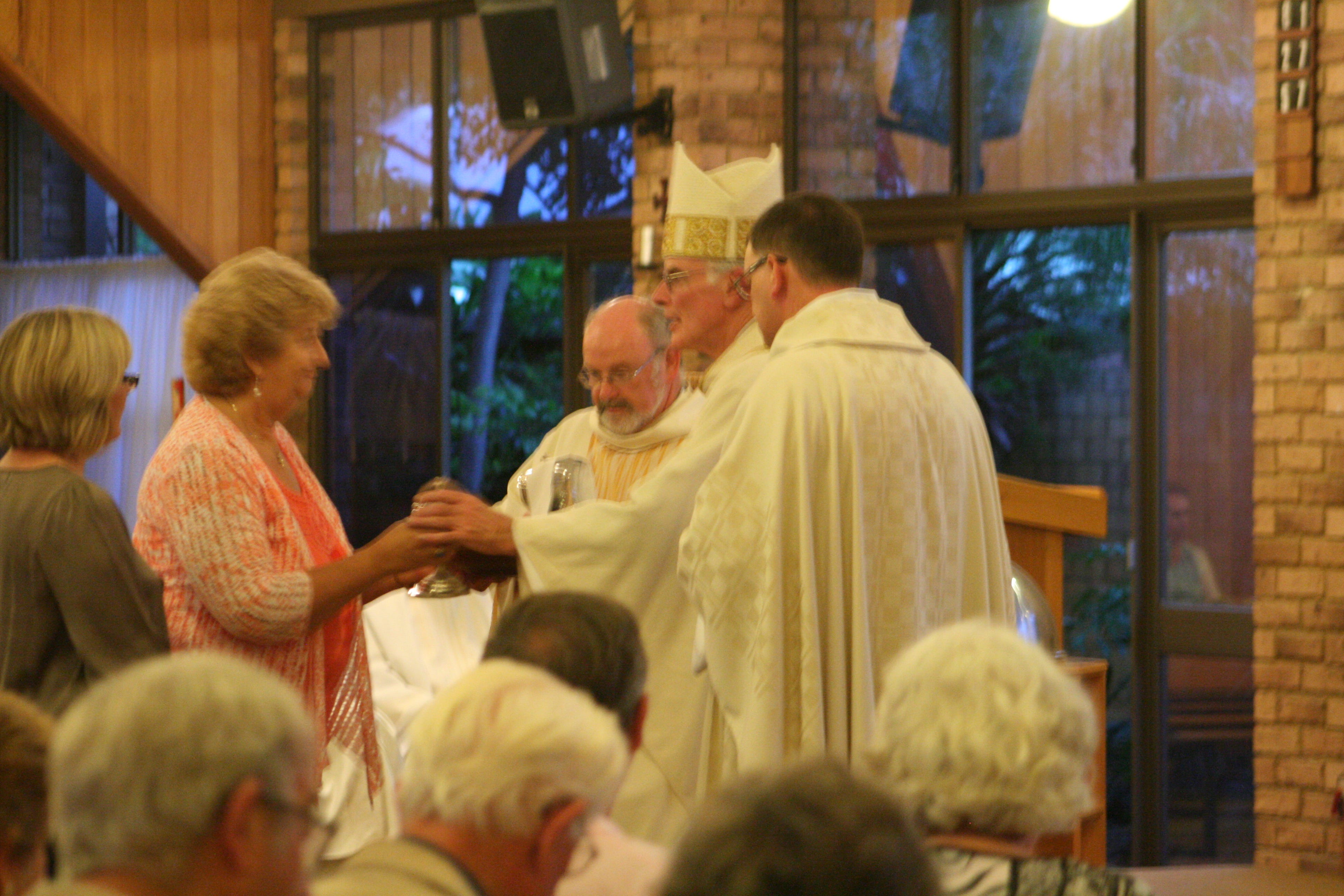
This perhaps is also part of the “spiritual efficacy and significance” that the GIRM speaks of, and thus to be considered in how the bread and wine are moved from one place in the church to be placed upon the altar.
Apart from the bread and wine, the only items that might be brought forward in processions are “money or other gifts for the poor or for the Church”, though “given their purpose they are to be put in a suitable place away from the Eucharistic table” (n.73). It is very clear that such items should not be anywhere near the altar, despite this being a common enough sight.
The primary reason they should not be put near the altar is a simple one: unlike the bread and wine, they will not be returned to the gathered assembly. They will be used in other ways to support those in need, or to meet the needs of the parish in which the church is located, or to support the mission of the Church in some fashion.
Since they are not to be blessed in the same way as the bread and wine, they rightly are not treated in the same manner as the bread and wine. If they are brought forward, and there is no absolute demand that they should be, they are placed elsewhere to be attended to after the liturgical actions are brought to a close.
There are a few more parts of the “Take” part of the Liturgy of the Eucharist, but they can wait until the next instalment in the series. So stay tuned for next week and for Part 4 of our exploration of the Liturgy of the Eucharist.
To be continued…