The Liturgy of the Eucharist - Part 11
Part eleven of a series I am writing for inclusion in the weekly bulletin of St Francis of Assisi Parish, Dungog Gresford

With the conclusion of the Eucharistic Prayer, the Liturgy of the Eucharist moves on to the Communion Rite. This Rite contains a number of individual ritual elements.
The first of these elements is the praying of The Lord’s Prayer, that prayer which Jesus himself gave to his disciples when they asked him to teach them to pray, and which has been handed down across generations and millennia to this very day.
The liturgical praying of The Lord’s Prayer is divided into four distinct parts: the invitation, the prayer itself, the embolism, and the doxology.
The invitation is made by the Presider after the gathered assembly have stood and, in the current translation, is a fixed text: “At the Saviour’s command and formed by divine teaching, we dare to say”.
Such an invitation is very clear and distinct and should not begin until the gathered assembly have, in fact, stood and are ready to join together in prayer. Unfortunately, there are occasions when the Presider begins this invitation while members of the assembly are still transitioning from kneeling to standing. Such an unfortunate practice should always be avoided.
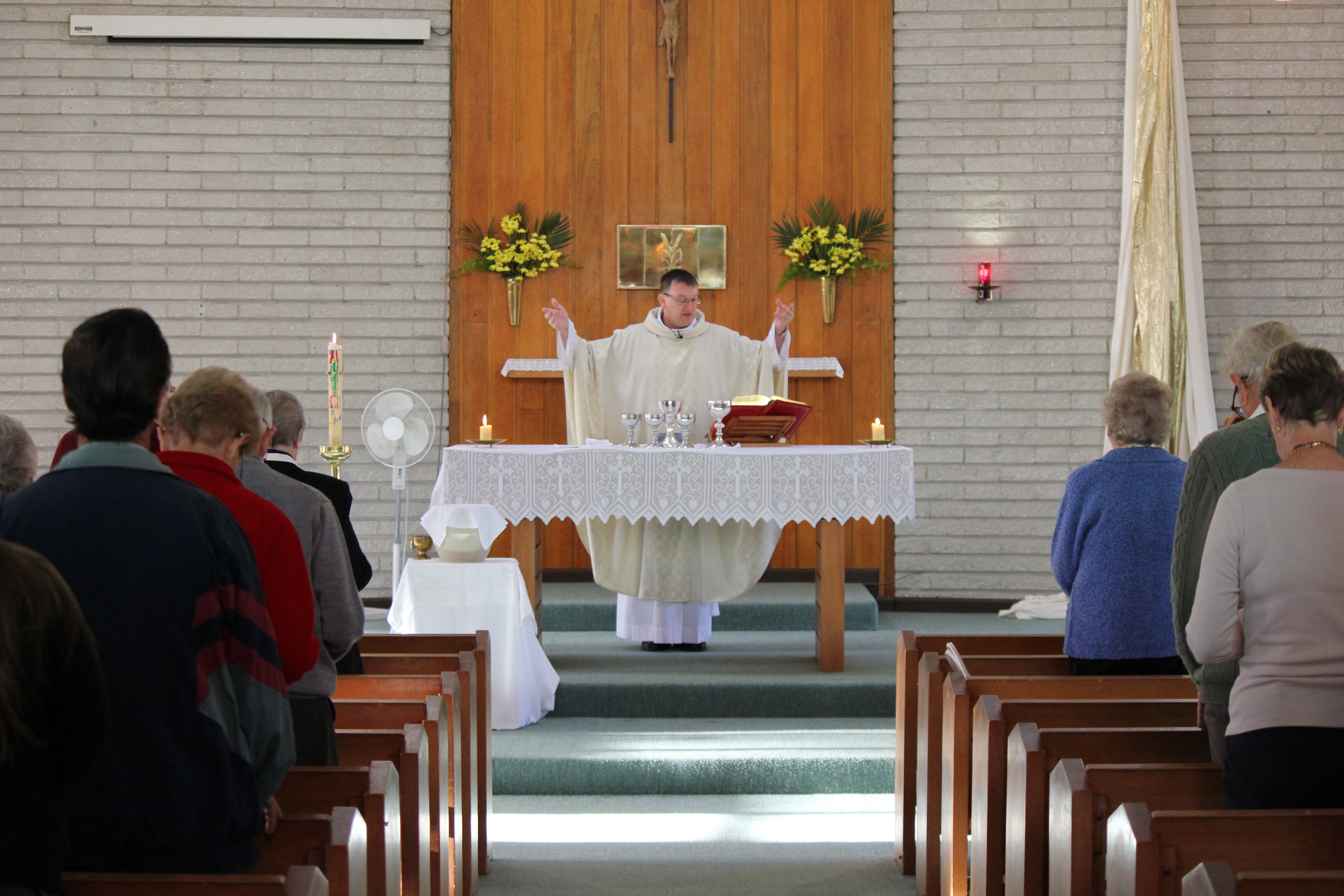
After the invitation has been made, The Lord’s Prayer is prayed by all those present, with the Presider extending his hands while doing so.
At the end of the text of The Lord’s Prayer, the Presider continues with what is known as the embolism, an extension or development of the final petition found in The Lord’s Prayer (“Deliver us, Lord, we pray, from every evil…).
The embolism invites the gathered assembly to pray the doxology (“For the kingdom, the power and the glory are yours now and for ever.”) which brings the first ritual element of the Communion Rite to a close.
Having prayed the prayer of Jesus, the Communion Rite moves on to celebrating the Rite of Peace
“by which the Church entreats peace and unity for herself and for the whole human family, and the faithful express to each other their ecclesial communion and mutual charity before communicating in the Sacrament” (GIRM, n.82)
The brief dialogue between Presider and the gathered assembly ends with an invitation from the Presider: “Let us offer each other the sign of peace.”
The original text of the General Instruction of the Roman Missal leaves the means by which this is undertaken to the discretion of local Conferences of Bishops.
The Australian Bishops determined that
“In the dioceses of Australia the most common form of the gesture of peace is the handshake, although different practices according to region and culture are not excluded. However, it is appropriate that each person offer the sign of peace only to those who are nearest and in a sober manner.” (GIRM, n.82)
As such, the sign of peace is not meant to be offered to everyone in the gathered assembly nor is it meant to be overly demonstrative.
Leaving one’s seat to offer the sign of peace to someone on the other side of the building would be most inappropriate, as is, I would suggest, speaking loudly in order to offer the peace to those more than a few seats away. Offering the sign of peace does not require it to be offered to everyone; but it does require it to be offered to those closest to where we are standing.
It should also be noted that members of the gathered assembly do not need to offer the Presider a sign of peace since he has already offered it to everyone present in the gathered assembly.
The sign of peace should not be artificially curtailed or extended, and once it has been offered to those to whom it should legitimately be offered, the liturgy moves on to the next ritual element. And what comes next can wait until Part 12 of the series.
To be continued…
Discussion about this post