

At the end of Part 4, the gifts of bread and wine have been received, prepared and placed upon the altar, and the Presider has washed his hands to symbolise “the desire for interior purification” (GIRM, n.76).
As part of the transition from the “Take” part of the Liturgy of the Eucharist to the “Bless” part, the Presider says the Prayer over the Offerings, one of the prayers that make up the Proper of the Mass (along with the Collect and the Prayer after Communion).
The General Instruction of the Roman Missal covers this very succinctly in n.77, while the Order of Mass provides a little more detail in nn.29-30.
The Prayer over the Offerings begins with an invitation to the entire assembly to pray, along with the Presider, that what is about to be offered, i.e., the gifts of bread and wine, will be acceptable to God.
At the end of this invitation, the assembly stands and responds accordingly, before the Presider extends his hands and prays the Prayer over the Offerings set down for that particular celebration.
The assembly gives its assent to that prayer by saying “Amen”. With that “Amen”, the gathered assembly moves to the praying of the Eucharistic Prayer.
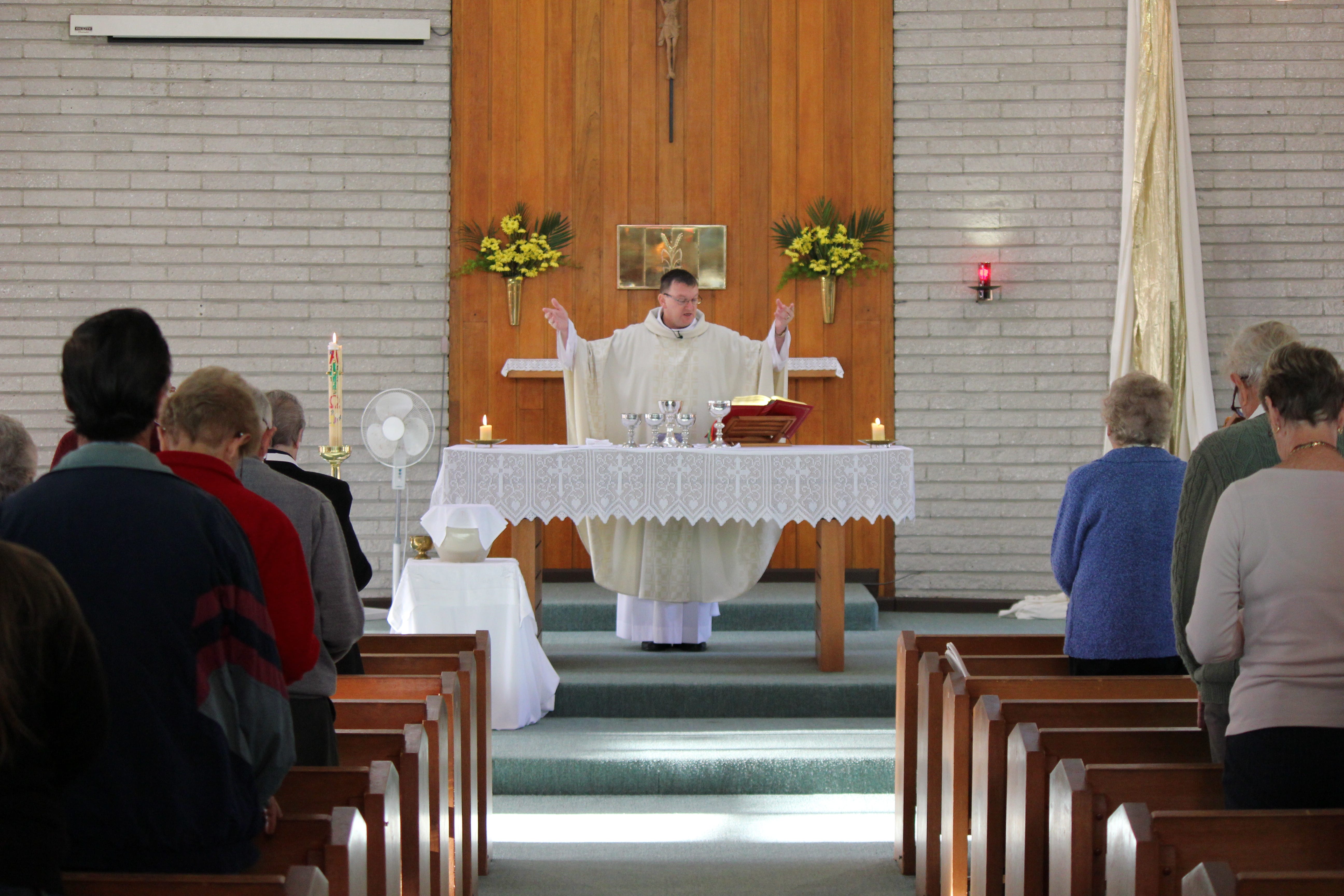
The General Instruction of the Roman Missal captures the fundamental nature of the Eucharistic Prayer in n.78, which is worth quoting in full:
Now the centre and high point of the entire celebration begins, namely, the Eucharistic Prayer itself, that is, the prayer of thanksgiving and sanctification. The [Presider] calls upon the people to life up their hearts towards the Lord in prayer and thanksgiving; he associates the people with himself in the Prayer that he addresses in the name of the entire community to God the Father through Jesus Christ in the Holy Spirit. Furthermore, the meaning of this Prayer is that the whole congregation of the faithful joins with Christ in confessing the great deeds of God and in the offering of Sacrifice. The Eucharistic Prayer requires that everybody listens to it with reverence and in silence.
Before moving on, there are a couple of things that flow from this description that are worthy of some additional commentary.
Firstly, the Eucharistic Prayer is not the prayer of the presiding priest. At least, it is not his alone. The entire Eucharistic Prayer is prayed by the gathered assembly, although spoken aloud by the Presider “in the name of the entire community”. This is not simply something “Father says”; this is our prayer, the prayer of the priestly people of God joined “with Christ in confessing the great deeds of God and in offering Sacrifice”.
And secondly, because the Eucharistic Prayer is very much the prayer of the entire gathered assembly, its praying requires an active attentiveness “in reverence and silence”. We do not ‘turn off’ at this point, nor perhaps should we become distracted by making sure we’re on the right page of the personal missal in our hands. Our reverence and silence is exercised by listening to the prayer, our prayer, being spoken aloud on our behalf by the presiding priest. This “centre and high point of the entire celebration” surely warrants, indeed requires, our clear, undivided attention.
Next week, in Part 6 of our exploration of the Liturgy of the Eucharist, we will continue looking at the nature and content of the Eucharistic Prayer.
To be continued…