

At the end of Part 8 we found ourselves looking at the Institution narrative of the Eucharistic Prayer. These words, the words used by Jesus at the Last Supper, are an important part of the Eucharistic Prayer and there are clear instructions surrounding how they should be pronounced and the ritual actions that accompany them.
The Order of Mass contains a very important direction in this regard: “In the formulas that follow, the words of the Lord should be pronounced clearly and distinctly, as the nature of these words requires” (cf. nn. 89, 102, 110, and 119).
Occasionally it is possible to encounter a Presider who overly exaggerates “the words of the Lord” during the Institution narrative or pronounces them in an overly theatrical manner. Such an approach would seem to be contrary to the requirement indicated by a plain reading of “clearly and distinctly”, an approach that perhaps should not alter the voice of the Presider in any way but rather ask the Presider to be careful in the manner these words are pronounced.
The ritual actions that accompany “the words of the Lord” are also specified in the Order of Mass in each of the four main Eucharistic Prayers (cf. nn. 89-90, 102-103, 110-111, and 119-120).
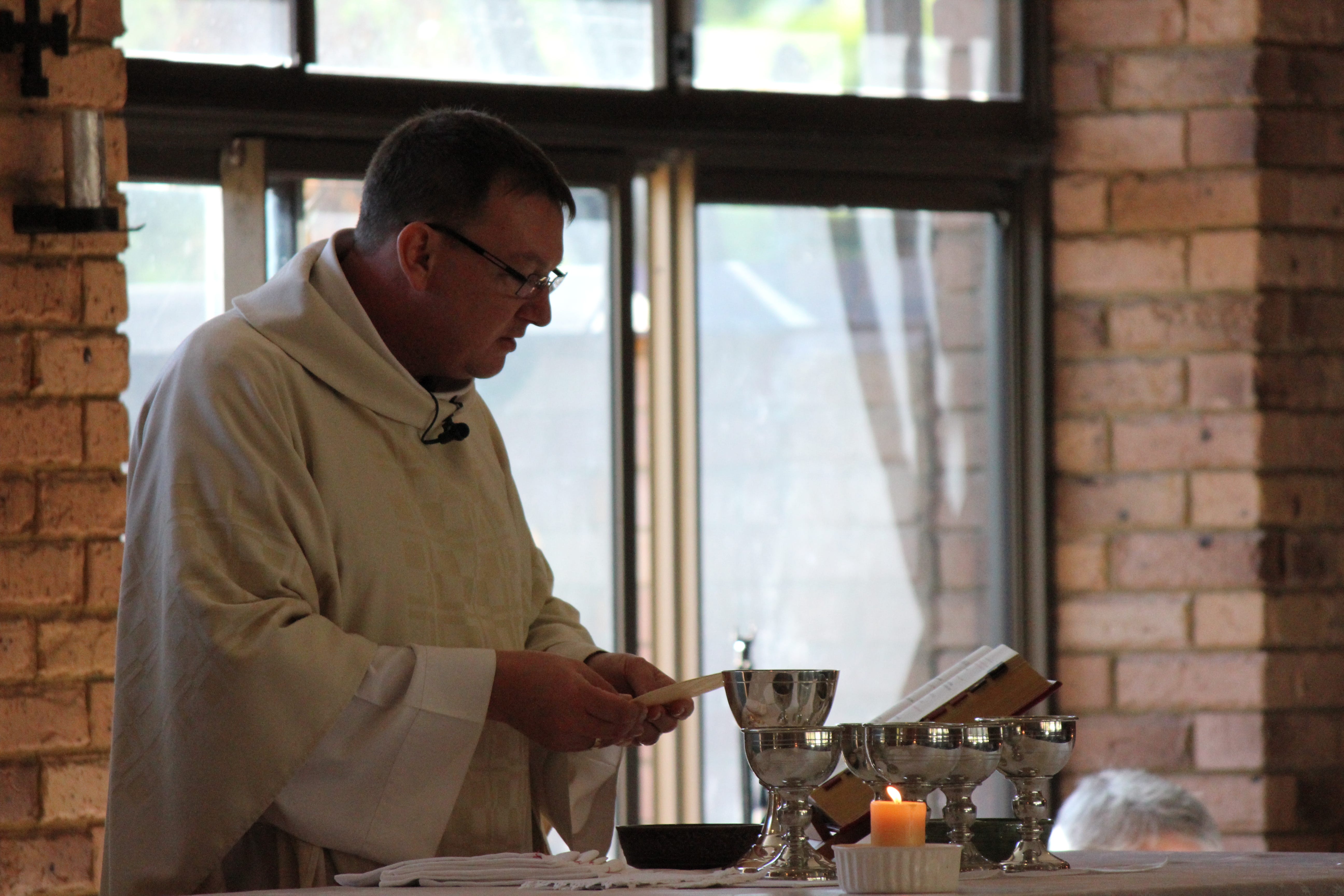
In summary these are:
· the taking of the bread or chalice from the altar to be held “slightly” above the altar. There is no requirement for the bread or chalice to held in such a way that the Presider appears to be speaking directly towards it.
· the Presider bows slightly before speaking the “words of the Lord”. This is not an exaggerated bow as is sometimes encountered wherein the Presider bows low over the altar; it’s a slight bow of the upper body. It may be helpful for a short pause to be observed by the Presider while he executes this slight change of posture.
· after speaking “the words of the Lord”, the Presider shows the consecrated host or chalice to the Assembly. The word chosen to be used here is “show” not “elevate”, which clearly means that there is a difference. The height of a “showing” when Mass is celebrated facing the Assembly, would be much lower than when it is not, and this should mean that an exaggerated height is inappropriate. I would suggest that anything above the Presider’s head is simply too high and has moved from “showing” to an “elevation”. The choice of the word “show” rather than “elevate” perhaps also indicates for how long the “showing” should last: not that long at all, seconds rather than minutes.
· after the Presider shows the consecrated host or chalice to the Assembly, they are returned to the altar and the Presider then genuflects in adoration. It should be noted that there is no mention here of the Assembly adoring the consecrated host or chalice, either during the “showing” or afterwards. Given that the Assembly should be watching the actions of the Presider, rather than averting their eyes as was sometimes encouraged in pre-conciliar celebrations, the adoration of the Assembly could be argued to have already taken place before the Presider returns the consecrated host or chalice to the altar.
The combination of “the words of the Lord” and the required ritual actions specified in the Order of Mass ensures that the Institution narrative is celebrated well and appropriately as is necessary for any part of the Eucharistic Prayer.
Having completed the Institution narrative, the celebration of the Liturgy of the Eucharistic continues with the next part of the Eucharistic Prayer. But that can wait until next week and Part 9 of the series.
To be continued…